
🇬🇧 – 🇮🇹
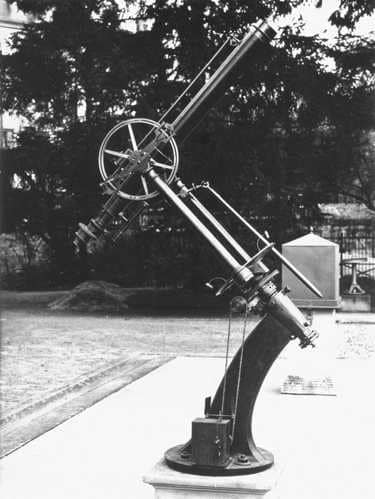
In 1816 was born the Swiss astronomer Rudolf Wolf, known for having introduced the relative number of wolf [R=K x (10G+M)] in 1848 to determine an estimate of solar activity. Particularly dedicated to the study of sunspots, he collected their observations from the time of Galileo. In the photo we see the Fraunhofer 83/1320 mm refractor, on the terrace of the astronomical observatory in Zurich in 1880, which Rudolf Wolf used for his observations.
Nel 1816 nasce l’astronomo svizzero Rudolf Wolf, noto per aver introdotto nel 1848 il numero relativo di wolf [R=K x (10G+M)] per determinare una stima dell’attività solare. Dedicatosi specialmente allo studio delle macchie solari, ne raccolse le osservazioni fin dal tempo di Galileo. Nella foto vediamo il rifrattore Fraunhofer 83/1320 mm, nella terrazza dell’osservatorio astronomico a Zurigo nel 1880, che utilizzava Rudolf Wolf per le sue osservazioni.

In 1914, the Italian astronomer and geodesist Giuseppe Lorenzoni (1843-1914) died. He began his career as an assistant in the astronomical observatory of Padua, from 1872 adjunct astronomer and from 1877 director. At the same time (1866-1912) he was professor of astronomy at the University and for several years of geodesy. He took care of the meteorological observations and drew remarkable results from them and from others previously made in Padua. He contributed directly and with his students to the observations and research on shooting stars, promoted by Schiaparelli’s studies. He devoted himself successfully to the newly born spectroscopy. He treated topics of optics but above all he had a prominent part in the work of the Italian Geodetic Commission with his numerous operations of geodetic astronomy and gravimetry, in particular with the determination of absolute gravity which placed Padua among the most important gravimetric stations in the world. An asteroid, 40447 Lorenzoni, has been named after him.
Nel 1914 muore l’astronomo e geodeta italiano Giuseppe Lorenzoni (1843-1914). Iniziò il suo percorso come assistente nell’osservatorio astronomico di Padova, dal 1872 astronomo aggiunto e dal 1877 direttore. Contemporaneamente (1866-1912) fu professore di astronomia all’Università e per parecchi anni di geodesia. Curò le osservazioni meteorologiche e trasse da esse e da altre, fatte precedentemente in Padova, notevoli risultati. Contribuì direttamente e con i suoi allievi alle osservazioni e alle ricerche nelle stelle cadenti, promosse dagli studi dello Schiaparelli. Si dedicò con fortuna alla spettroscopia da poco sorta. Trattò argomenti di ottica ma soprattutto ebbe parte preminente nei lavori della Commissione Geodetica Italiana con le sue numerose operazioni di astronomia geodetica e di gravimetria, in particolare con la determinazione della gravità assoluta che pose Padova fra le stazioni gravimetriche piú importanti del mondo. Gli è stato dedicato un asteroide, 40447 Lorenzoni.
In 1959, Regulus was occulted by Venus. The next occultation will occur on October 1, 2044.
Nel 1959 avviene l’occultazione di Regolo da parte di Venere. Leggiamo in cosa consiste l’occultazione. La prossima occultazione avverrà il primo ottobre 2044.

In 1950 born Yuji Hyakutake (百武裕司; Japanese amateur astronomer) who discovered two comets: comet C/1995 Y1, on December 25, 1995, and comet Hyakutake (see photo), on January 30, 1996, using 25×150 binoculars. The media reported that Hyakutake became interested in astronomy after seeing Comet Ikeya-Seki (C/1965 S1). He died at the age of 51 of an aneurysm. Asteroid 7291 Hyakutake was named in his honour.
Nel 1950 nasce Yuji Hyakutake (百武裕司; astronomo amatoriale giapponese che ha scoperto due comete: la cometa C/1995 Y1, il 25 dicembre 1995, e la cometa Hyakutake (vedi foto), il 30 gennaio 1996, utilizzando un binocolo 25×150. I media hanno riportato che Hyakutake si è appassionato all’astronomia dopo aver visto la Cometa Ikeya-Seki (C/1965 S1). È morto all’età di 51 anni per un aneurisma. L’asteroide 7291 Hyakutake è stato così denominato in suo onore.
Text source: Wikipedia
Sostieni anche tu Wikipedia
Google translate
 Astronomy Bulletin Of the Day