
🇬🇧 – 🇮🇹


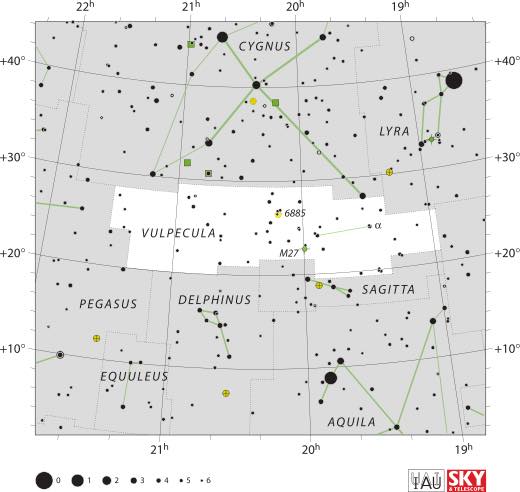
In 1764 the French astronomer Charles Messier discovered M27 “dumbbell nebula”, the first planetary nebula (in Vulpecula, see photo Liverpool Telescope). The Dumbbell Nebula is quite easy to locate, being about three degrees north of the star γ Sagittae, of magnitude 3.5 (see Sky telescope map); it is easily visible even with 10×50 binoculars and, if the night is very dark and clear, even with smaller instruments, such as an 8×30. A 114mm telescope is already able to show its main feature, a shape that vaguely resembles that of an hourglass due to the two large bright lobes that the cloud has; more powerful tools, preferably equipped with special filters, allow you to observe a large number of details and nuances. The central star, of magnitude 13.6, is often used as a test to verify the clarity of the starry night using 200mm aperture telescopes. As in many other planetary nebulae close to us, nodes are easily visible in M27 (see photos of the Hubble Space Telescope); its central region is marked by a level of dark and bright nodes associated with filaments. Nodes have a wide range of morphologies, ranging from symmetrical with filament tails to asymmetrical and tailless. Similarly to what was also observed in the Helix Nebula and the Eskimo Nebula, the heads of the nodes have bright cusps, corresponding to areas of local photoionization fronts. Personally I find this nebula beautiful both from an observational and photographic point of view.
Nel 1764 l’astronomo francese Charles Messier scopre M27 “nebulosa manubrio”, la prima nebulosa planetaria (nella Volpetta, vedi foto Liverpool Telescope). La Nebulosa Manubrio è piuttosto facile da localizzare, trovandosi circa tre gradi a nord della stella γ Sagittae, di magnitudine 3,5 (vedi mappa Sky telescope); è visibile con facilità anche con un binocolo 10×50 e, se la notte è molto buia e limpida, anche con strumenti più piccoli, come un 8×30. Un telescopio da 114mm è già in grado di mostrare la sua caratteristica principale, una forma che ricorda vagamente quella di una clessidra a causa dei due grossi lobi brillanti che la nube possiede; strumenti più potenti, meglio se dotati di appositi filtri, consentono di poter osservare un gran numero di dettagli e sfumature. La stellina centrale, di magnitudine 13,6, è spesso utilizzata come test per verificare la limpidezza della notte stellata utilizzando telescopi da 200mm di apertura. Come in molte altre nebulose planetarie vicine a noi, anche in M27 sono facilmente visibili dei nodi (vedi foto del telescopio spaziale Hubble); la sua regione centrale è segnata da un livello di nodi oscuri e brillanti, associati con dei filamenti. I nodi presentano una vasta gamma di morfologie, andando da quelli simmetrici con code a filamento fino a quelli asimmetrici e privi di coda. Similmente a quanto osservato anche nella Nebulosa Elica e nella Nebulosa Eschimese, le teste dei nodi hanno delle cuspidi luminose, corrispondenti ad aree di locali fronti di fotoionizzazione. Personalmente trovo questa nebulosa stupenda sia dal punto di vista osservativo che fotografico.
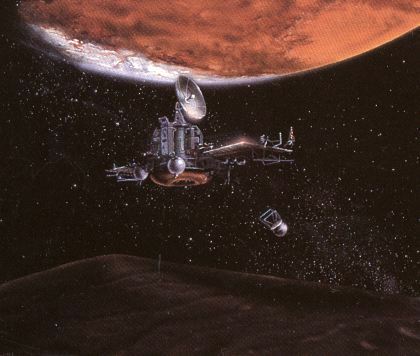
Phobos 2 was launched in 1988, the last Soviet Mars exploration mission before the dissolution of the USSR
Nel 1988 viene lanciato Phobos 2, ultima missione sovietica esplorativa di Marte prima dello scioglimento dell’URSS

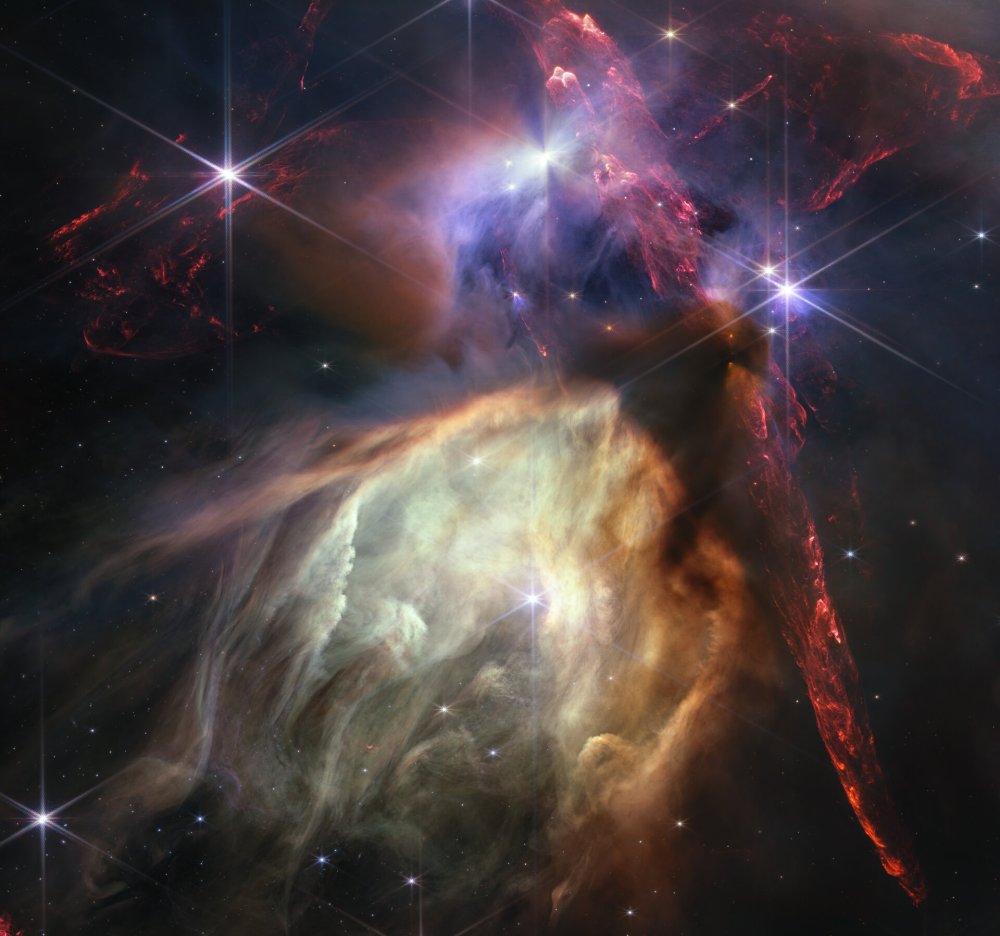
2022: tonight the James Webb Telescope gave its best with this first Deep Field image in infrared thanks to the NIRCam camera (total exposure time of 12.5 hours)! What we see is the galaxy cluster SMACS 0723 in the southern constellation of the Flying Fish and thanks to the phenomenon of gravitational lensing that amplifies the light we see the very distant back galaxies in the shape of an arc deformed by the gigantic mass of SMACS 0723! It seems to dive into an immense sea of stars despite being located in a tiny area! The light from the cluster took 4.6 billion years to reach us, but that from the galaxies behind it took a good 13 billion years, leaving “alone” a billion years after the Big Bang! So today we celebrate one year with the photo of the JWST Telescope chosen by ESA:
2022: stanotte il James Webb Telescope ha dato il meglio di se con questa prima immagine Deep Field in infrarosso grazie alla camera NIRCam (tempo totale di esposizione di 12,5 ore)! Questo che vediamo è l’ammasso di galassie SMACS 0723 nella costellazione australe del Pesce Volante e grazie al fenomeno della lente gravitazionale che amplifica la luce vediamo le lontanissime galassie retrostanti a forma di arco deformate dalla gigantesca massa di SMACS 0723! Sembra di tuffarsi in un mare immenso di stelle nonostante sia localizzato in un area minuscola! La luce dell’ammasso ha impiegato 4,6 miliardi di anni per arrivare a noi, ma quella delle galassie retrostanti ha impiegato ben 13 miliardi di anni partita da “solo” un miliardo di anni dopo il Big Bang! Oggi si festeggia un anno quindi con la foto del JWST Telescope scelta da ESA:
Text source: Wikipedia, ESA
Sostieni anche tu Wikipedia
Google translate
 Astronomy Bulletin Of the Day