
🇬🇧 – 🇮🇹
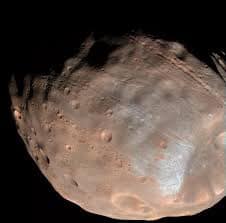
In 1877 the american astronomer Asaph Hall discovered Phobos, the largest and most internal of the two natural satellites of Mars (see photo). Nasa link: https://solarsystem.nasa.gov/moons/mars-moons/phobos/in-depth/
Nel 1877 l’astronomo americano Asaph Hall (1829-1907) scopre Phobos, il maggiore e il più interno dei due satelliti naturali di Marte (vedi foto). Link Nasa: https://solarsystem.nasa.gov/moons/mars-moons/phobos/in-depth/
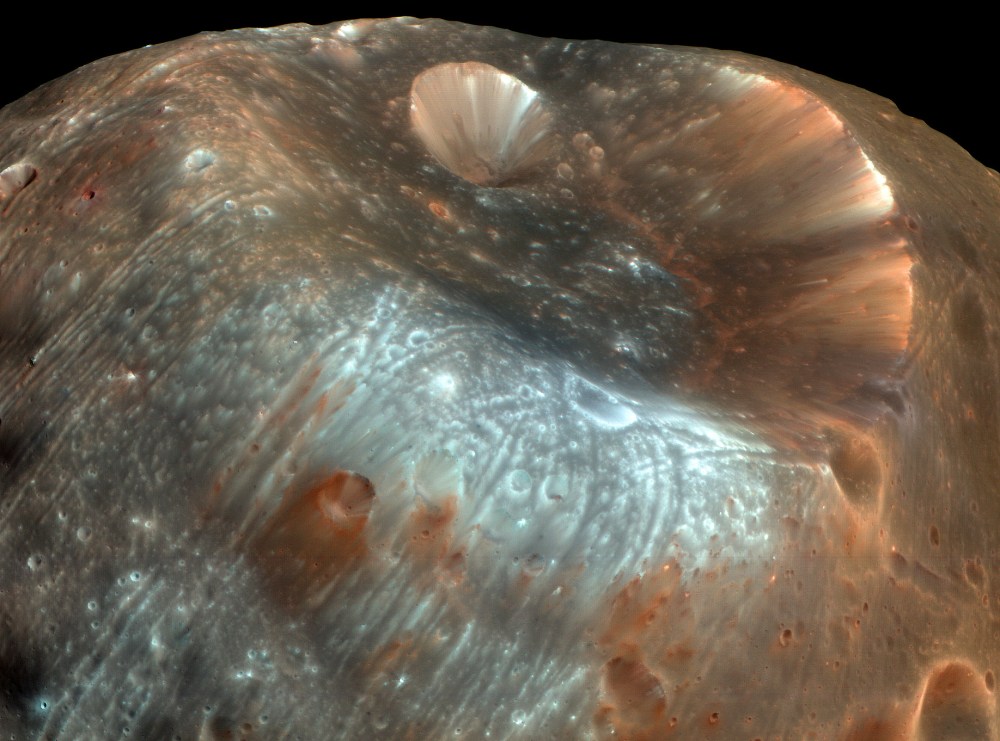
Stickney crater, Phobos. Image by Mars Reconnaissance Orbiter, 23 March 2008. http://photojournal.jpl.nasa.gov/catalog/PIA10368 The High Resolution Imaging Science Experiment (HiRISE) camera on NASA’s Mars Reconnaissance Orbiter took two images of the larger of Mars’ two moons, Phobos, within 10 minutes of each other on 23 March 2008. This is the first, taken from a distance of about 6,800 kilometers (about 4,200 miles). It is presented in color by combining data from the camera’s blue-green, red, and near-infrared channels. The illuminated part of Phobos seen in the images is about 21 kilometers (13 miles) across. The most prominent feature in the images is the large crater Stickney in the lower right. With a diameter of 9 kilometers (5.6 miles), it is the largest feature on Phobos. The color data accentuate details not apparent in black-and-white images. For example, materials near the rim of Stickney appear bluer than the rest of Phobos. Based on analogy with materials on our own moon, this could mean this surface is fresher, and therefore younger, than other parts of Phobos. A series of troughs and crater chains is obvious on other parts of the moon. Although many appear radial to Stickney in this image, recent studies from the European Space Agency’s Mars Express orbiter indicate that they are not related to Stickney. Instead, they may have formed when material ejected from impacts on Mars later collided with Phobos. The lineated textures on the walls of Stickney and other large craters are landslides formed from materials falling into the crater interiors in the weak Phobos gravity (less than one one-thousandth of the gravity on Earth). In the full-resolution version of this image, a pixel encompasses 6.8 meters (22 feet), providing a resolution (smallest visible feature) of about 20 meters (about 65 feet). The image is in the HiRISE catalog as PSP_007769_9010. NASA’s Jet Propulsion Laboratory, a division of the California Institute of Technology in Pasadena, manages the Mars Reconnaissance Orbiter for NASA’s Science Mission Directorate, Washington. Lockheed Martin Space Systems, Denver, is the prime contractor for the project and built the spacecraft. The High Resolution Imaging Science Experiment is operated by the University of Arizona, Tucson, and the instrument was built by Ball Aerospace & Technologies Corp., Boulder, Colo.
NASA/JPL-Caltech/University of Arizona – English Wikipedia – Original image and description.
Public Domain
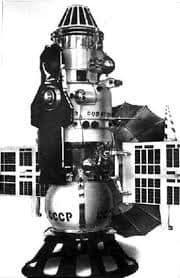
In 1970 Venera 7 is launched (see photo of the probe) with the mission of studying the lower layers of the Venusian atmosphere. Venera 7 landed on the Venus surface on December 15th 1970, it was the first space probe ready to transmit data from another planet. Video: https://youtu.be/V4EbbaUIDl0
Nel 1970 viene lanciata Venera 7 (vedi foto), scopo della missione: studiare i bassi strati dell’atmosfera venusiana. Raggiungerà Venere il 15 dicembre 1970 diventando la prima sonda spaziale a trasmettere dati da un altro pianeta
To receive the Astronomy Bulletin Of the Day in your inbox, please put your email address on the contact form: https://abod.blog/contacts/
Per ricevere il bollettino per gli astronaviganti giornaliero nella tua posta elettronica, inserisci la tua mail nel form contatti: https://abod.blog/contacts/
Text and video source: Wikipedia, NASA, YouTube
Sostieni anche tu Wikipedia
Google translate
 Astronomy Bulletin Of the Day

