
🇬🇧 – 🇮🇹

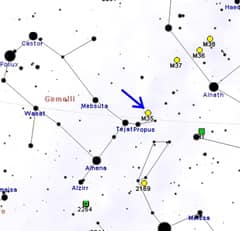
In 1764 the astronomer Charles Messier cataloged the open cluster M35 (see photo) in the constellation Gemini (see map) already discovered in 1745 by De Cheseaux.
Nel 1764 l’astronomo Charles Messier cataloga l’ammasso aperto M35 (vedi foto) nella costellazione dei Gemelli (vedi mappa) già scoperto nel 1745 lo da De Cheseaux.
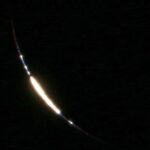
In 1844 the English astronomer Francis Baily died to whom we owe the study of the phenomenon of optical-luminous effects that occur naturally during a total solar eclipse called precisely Baily’s beads (see photo).
Nel 1844 muore l’astronomo inglese Francis Baily a cui si deve lo studio del fenomeno di effetti ottici-luminosi che avvengono naturalmente durante un’eclissi solare totale detti appunto grani di Baily (vedi foto).
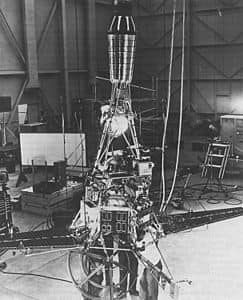
In 1961 Ranger 1 (see photo) re-entered the Earth’s atmosphere. The main objective was to test the components and functions needed for subsequent lunar and space exploration missions.
Nel 1961 la Ranger 1 (vedi foto) rientra nell’atmosfera terrestre. L’obiettivo principale era testare i componenti e le funzioni necessarie per le successive missioni esplorative lunari e spaziali.
In 2004, the American astronomer Fred Whipple died, remembered for having defined comets as dirty snowballs after long studies that highlighted their composition, a definition still used to describe these celestial bodies. Comet discoveries include 36P/Whipple and C/1942 C1 Whipple-Bernasconi-Kulin.
Nel 2004 muore l’astronomo statunitense Fred Whipple, ricordato per aver definito, dopo lunghi studi che ne misero in evidenza la composizione, le comete come palle di neve sporche, definizione ancora usata per descrivere questi corpi celesti. Tra le scoperte cometarie si evidenziano la 36P/Whipple e la C/1942 C1 Whipple-Bernasconi-Kulin.
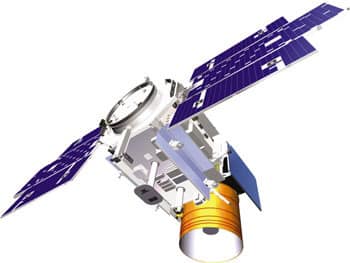
In 2010 the satellite ICESat (Ice, Cloud, and land Elevation Satellite) re-entered the atmosphere destroying itself, see image, launched by NASA for the study of ice caps (by measuring their mass balance, cloud height and aerosol above them), their topographic survey and the characteristics of the vegetation present on them using the GLAS (Geoscience Laser Altimeter System) instrument.
Nel 2010 rientra nell’atmosfera distruggendosi il satellite ICESat (Ice, Cloud, and land Elevation Satellite), vedi immagine, lanciato dalla NASA per lo studio delle calotte glaciali (attraverso la misurazione del loro bilancio di massa, dell’altezza delle nubi e dell’aerosol al di sopra di esse), di un loro rilevamento topografico e delle caratteristiche della vegetazione presente su di esse mediante lo strumento GLAS (Geoscience Laser Altimeter System).
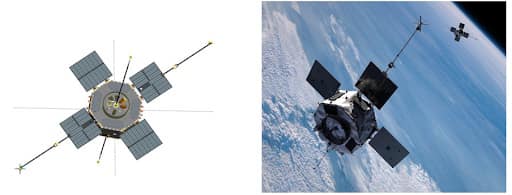
In 2012, the two twin RBSP (Radiation Belt Storm Probes) were launched, see image, for the study of the regions of the circumterrestrial space indicated as the Van Allen Belts.
Nel 2012 lancio delle due sonde gemelle RBSP (Radiation Belt Storm Probes), vedi immagine, per lo studio delle regioni dello spazio circumterrestre indicate come Fasce di Van Allen.
To receive the Astronomy Bulletin Of the Day in your inbox, please put your email address on the contact form: https://abod.blog/contacts/
Per ricevere il bollettino per gli astronaviganti giornaliero nella tua posta elettronica, inserisci la tua mail nel form contatti: https://abod.blog/contacts/
Text, images and video source: Wikipedia, NASA
Sostieni anche tu Wikipedia
Google translate
 Astronomy Bulletin Of the Day