
🇬🇧 – 🇮🇹

In 1561 the Austrian astronomer Christoph Grienberger was born, a Jesuit who dealt not only with astronomy but also with optics. Gruemberger Crater on the Moon was named after him (see photo).
Nel 1561 nasce nasce l’astronomo austriaco Christoph Grienberger, gesuita che si occupò oltre chi astronomia anche di ottica. A lui è stato intitolato il Cratere Gruemberger sulla Luna (vedi foto).
In 1847 Alfonso Di Legge was born, an Italian mathematician and astronomer; many observations of solar spectroscopy are highlighted, the determination of the latitudes, longitudes and average ascents of thousands of stars and, above all, the publication, with Francesco Giacomelli, of the Capitoline Stellar Catalogue, a work begun by his master Respighi.
Nel 1847 nasce Alfonso Di Legge, matematico e astronomo italiano; si evidenziano molte osservazioni di spettroscopia solare, la determinazione delle latitudini, longitudini ed ascensioni medie di migliaia di stelle e, soprattutto, la pubblicazione, con Francesco Giacomelli, del Catalogo Stellare Capitolino, lavoro iniziato dal suo maestro Respighi.

Hans Albrecht Bethe, a German physicist and astronomer naturalized in the United States, was born today in 1906. He headed the theoretical division of the Manhattan Project to build the atomic bomb at Los Alamos. In 1938 he identified a cycle of thermonuclear reactions at the origin of the energy of the sun and most of the stars (Bethe cycle). In fact, he specified how the process of transformation of hydrogen into helium takes place in a star, and he identified the fact that, in stars with a mass greater than the sun, hydrogen is transformed into helium with the help of another element, carbon, which acts as a catalyst. This theory made possible a revision of the H-R diagram (see image on the left). It was thanks to this discovery that in 1967 he was awarded the Nobel Prize in Physics.
Nel 1906 nasce Hans Albrecht Bethe, fisico e astronomo tedesco naturalizzato statunitense. Diresse la divisione teorica del progetto Manhattan per la costruzione della bomba atomica a Los Alamos. Nel 1938 individuò un ciclo di reazioni termonucleari all’origine dell’energia del sole e della maggior parte delle stelle (ciclo di Bethe). Precisò, infatti, come si svolge in una stella il processo di trasformazione dell’idrogeno in elio, e individuò il fatto che, nelle stelle di massa maggiore del sole, l’idrogeno viene trasformato in elio con l’aiuto di un altro elemento, il carbonio, che funge da catalizzatore. Questa teoria rese possibile una revisione del diagramma H-R (vedi immagine a sinistra). Fu grazie a questa scoperta che nel 1967 gli fu assegnato il premio Nobel per la fisica.
Born in 1942 Lutz D. Schmadel, a German astronomer, prolific discoverer of asteroids, with a special interest in their orbit. Among the asteroids discovered are 8661 Ratzinger, 10114 Greifswald and 11508 Stolte.
Nasce nel 1942 Lutz D. Schmadel, un astronomo tedesco, prolifico scopritore di asteroidi, con un interesse speciale per la loro orbita. Tra gli asteroidi scoperti ci sono 8661 Ratzinger, 10114 Greifswald e 11508 Stolte.
In 1981 asteroid 3495 Colchagua was discovered, a main belt asteroid with an orbit characterized by a semi-major axis of 3.2160994 AU and an eccentricity of 0.1218469, inclined by 2.47330° with respect to the ecliptic.
Nel 1981 viene scoperto l’asteroide 3495 Colchagua, un asteroide della fascia principale che presenta un’orbita caratterizzata da un semiasse maggiore pari a 3,2160994 UA e da un’eccentricità di 0,1218469, inclinata di 2,47330° rispetto all’eclittica.
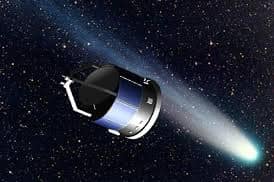
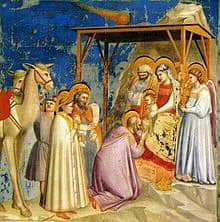
In 1985 the Giotto mission was launched from the Kourou launch base, a European mission of the European Space Agency designed to reach and study Halley’s comet. The probe (see image) takes its name from the medieval painter Giotto who observed Halley’s comet in 1301 and from this he took the inspiration for the star of Bethlehem depicted in the “Nativity” of the Scrovegni chapel (see image).
Nel 1985 viene lanciata la Missione Giotto dalla base di lancio di Kourou, una missione Europea dell’Agenzia Spaziale Europea progettata per raggiungere e studiare la cometa di Halley. La sonda (vedi immagine) prende il nome dal pittore medioevale Giotto che osservò la cometa di Halley nel 1301 e da questa prese l’ispirazione per la stella di Betlemme raffigurata nella “Natività” della cappella degli Scrovegni (vedi immagine). Articolo UniPD: https://ilbolive.unipd.it/it/news/scienza-nascosta-nei-luoghi-padova-scrovegni
Text source: Wikipedia
Sostieni anche tu Wikipedia
Google translate
 Astronomy Bulletin Of the Day