
🇬🇧 – 🇮🇹

In 1617, the German astronomer David Fabricius died. He was a pupil of Tycho Brahe, he applied himself particularly to observational astronomy. He performed numerous and constant observations of a star located in the constellation of the Whale, Omicron Ceti, discovering its variability in 1596, following this discovery the star became known as Mira Ceti.
Nel 1617 muore l’astronomo tedesco David Fabricius. Fu allievo di Tycho Brahe, si applicò particolarmente all’astronomia di osservazione. Eseguì numerose e costanti osservazioni di una stella situata nella costellazione della Balena, Omicron Ceti, scoprendo nel 1596 la sua variabilità, in seguito a questa scoperta la stella divenne nota col nome di Mira Ceti.

🇬🇧 In 1998, the Space Shuttle Endeavor left for its first mission. Its construction began in 1987 to replace the Challenger, lost in an accident on January 28, 1986. Stock parts from the Atlantis and Discovery were used to assemble it.
🇮🇹 Nel 1998 lo Space Shuttle Endeavour parte per la sua prima missione. La sua costruzione iniziò nel 1987 per rimpiazzare il Challenger, perso in un incidente il 28 gennaio 1986. Per assemblarlo vennero utilizzati pezzi di scorta dell’Atlantis e del Discovery.

🇬🇧 In 2004 in Kiruna (Sweden), the Phoenix, a prototype of the Hopper orbital vehicle, successfully performed the test flight, landing without a crew. The Hopper has a similar shape to the Space Shuttle but differs from the latter in being a fully reusable single-stage vehicle. This means that, apart from the fuel consumed during the mission and any cargo released or collected in orbit, the configuration of the vehicle at take-off is identical to that at landing. The evolution of the Hoppers will follow with Elon Musk’s SpaceX space company (Starhopper initially called) of which we now see the various tests with the Starship project which has the objective of transporting humans to Mars.
🇮🇹 Nel 2004 a Kiruna (Svezia), il Phoenix, un prototipo del veicolo orbitale Hopper, effettua con successo il volo di prova, atterrando senza equipaggio. L’Hopper ha una forma simile allo Space Shuttle ma si distingue da quest’ultimo per essere un veicolo monostadio completamente riutilizzabile. Questo vuol dire che, a parte il carburante consumato durante la missione e il carico eventualmente rilasciato o raccolto in orbita, la configurazione del veicolo al decollo è identica a quella dell’atterraggio. Seguirà l’evoluzione degli Hopper con l’azienda spaziale SpaceX di Elon Musk (Starhopper chiamati inizialmente) di cui ora vediamo i vari test con il progetto Starship che ha l’obiettivo del trasporto umano verso Marte.
🇬🇧 In 2014, the British astrophysicist Colin Pillinger, professor at the Open University and chief instrumentation researcher at ESA, died. He was one of the reference scientists for the Beagle 2 Martian lander (see photo of the probe’s discovery on Mars) and devoted much of his work to the study of Martian meteorites.
🇮🇹 Nel 2014 muore l’astrofisico inglese Colin Pillinger, professore della Open University e ricercatore capo di strumentazione presso l’ESA. È stato uno degli scienziati di riferimento per il lander marziano Beagle 2 (vedi foto del ritrovamento su Marte della sonda) e ha dedicato molto del suo lavoro allo studio delle meteoriti marziane.

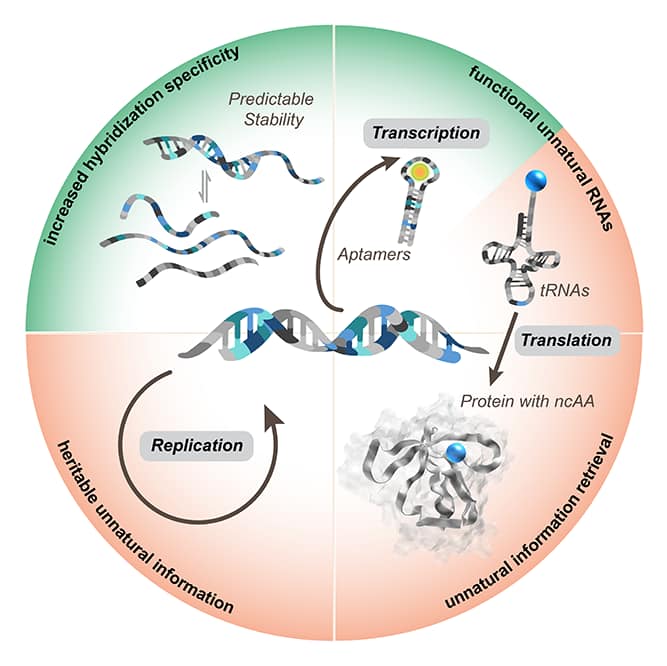
🇬🇧 In 2014, the scientific discovery was announced by the team of biologist Floyd Romesberg (from the Scripps Research Institute in California, USA): the first living organism with an ‘enhanced’ DNA was obtained: alongside the traditional four letters which make up ‘the alphabet of life’ two have been added, called X and Y. It is the first semi-synthetic organism, capable of replicating itself and maintaining its ‘fixed’ DNA, and represents a fundamental new chapter in synthetic biology. The new pair of letters has been inserted into the genome of a common Escherichia coli bacterium alongside the traditional pairs of letters A-T and C-G, the building blocks that form the alphabet of life in every living thing on Earth. The new letters did not alter the functioning of the bacterium, which replicated and transmitted them to the n ew generations. See diagram.
🇮🇹 Nel 2014 viene annunciata la scoperta scientifica dal team del biologo Floyd Romesberg (dello Scripps Research Institute della California, USA): è stato ottenuto il primo organismo vivente con un Dna ‘potenziato’: accanto alle tradizionali quattro lettere che costituiscono ‘l’alfabeto della vita’ ne sono state aggiunte due, chiamate X e Y. E’ il primo organismo semi-sintetico, capace di replicarsi e mantenere il suo Dna ‘truccato’, e rappresenta un nuovo fondamentale capitolo della biologia sintetica. La nuova coppia di lettere è stata inserita all’interno del genoma di un comune batterio Escherichia coli al fianco delle tradizionali coppie di lettere A-T e C-G, i mattoni che formano l’alfabeto della vita in ogni essere vivente della Terra. Le nuove lettere non hanno alterato il funzionamento del batterio, che replicandosi le ha trasmesse alle nuove generazioni. Vedi schema.
 Astronomy Bulletin Of the Day