
🇬🇧 – 🇮🇹
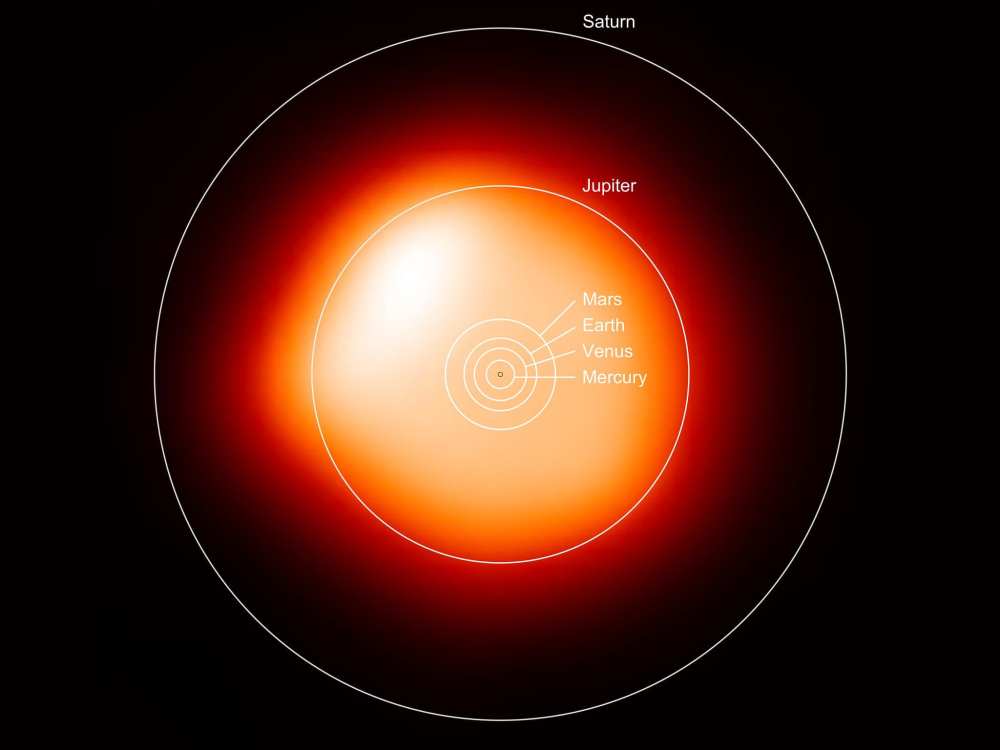
In 1920, astronomers Albert Abraham Michelson and Francis Gladhelm Pease, with the interferometer they applied to the 2.5 meter telescope on Mount Wilson in California, managed to estimate the diameter of Alfa Orionis (Betelgeuse, see photo with the Atacama Large Millimeter / submillimeter Array / ALMA). It should be noted that all stars are practically point-like even for the largest telescopes, however for Alfa Orionis it was possible to appreciate its diameter and this is their report: “Assuming that the effective wavelength for α Orionis is λ 5750, the its angular diameter obtained from the formula α = 1.22 λ/b turns out to be 0ˮ.047; and with a parallax of 0ˮ.018, its linear diameter is 240 × 10⁶ miles, or slightly less than the orbit of Mars. This value corresponds to a uniformly illuminated disk, while, for one darkened at the edge, this result should be increased by about 17 percent. The uncertainty in measuring the angular diameter is around 10 percent.”
Nel 1920 gli astronomi Albert Abraham Michelson e Francis Gladhelm Pease con l’interferometro da essi applicato al telescopio da 2,5 metri del Monte Wilson in California, riuscirono a stimare il diametro di Alfa Orionis (Betelgeuse, vedi foto con l’Atacama Large Millimeter / submillimeter Array / ALMA). Da rilevare che tutte le stelle sono praticamente puntiformi anche per i maggiori telescopi, tuttavia per Alfa Orionis è stato possibile apprezzare il suo diametro e questo il loro resoconto: “Assumendo che l’effettiva lunghezza d’onda per α Orionis sia λ 5750, il suo diametro angolare ricavato dalla formula α = 1,22 λ/b risulta essere 0ˮ,047; e con una parallasse di 0ˮ,018, si ottiene che il suo diametro lineare è 240 × 10⁶ miglia, ovvero leggermente meno dell’orbita di Marte. Questo valore corrisponde a un disco uniformemente illuminato, mentre, per uno oscurato al bordo, tale risultato dovrebbe essere aumentato di circa il 17 per cento. L’incertezza nella misurazione del diametro angolare è intorno al 10 per cento”.
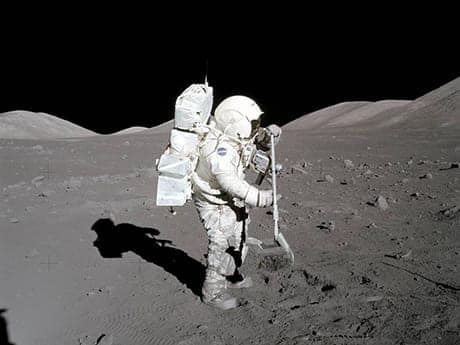
In 1972 two astronauts from the Apollo 17 program (Eugene Cernan and Harrison Schmitt) began the sixth and final extravehicular activity on the Moon (see photo), the last human mission on the Moon of the 20th century, which ended on 14 December at 05:40 UTC (see photo).
Nel 1972 due astronauti del programma Apollo 17 (Eugene Cernan e Harrison Schmitt) cominciano la sesta e ultima attività extraveicolare sulla Luna (vedi foto), l’ultima missione umana sulla Luna del XX secolo, conclusasi il 14 dicembre alle 05:40 UTC (vedi foto).
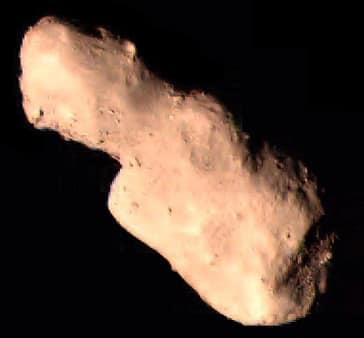
In 2012 the Chang’e probe flies over the asteroid Toutatis (see photo)
Nel 2012 la sonda Chang’e sorvola l’asteroide Toutatis (vedi foto)
Text source: Wikipedia
Sostieni anche tu Wikipedia
Google translate
 Astronomy Bulletin Of the Day